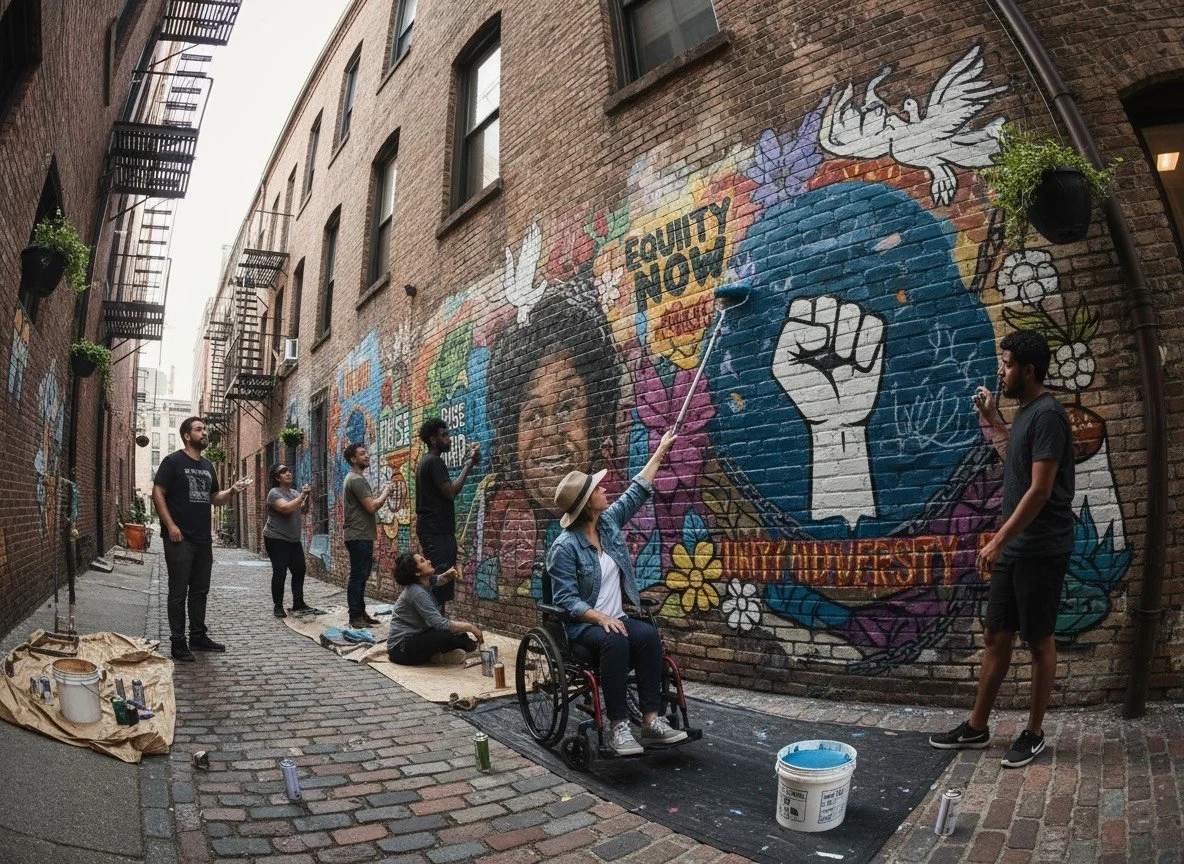
Graffiti as a Visual Diary
Graffiti often serves as a "visual diary" or a megaphone for those whose perspectives are omitted from mainstream media and history books. It functions as a form of “ontological assertion”, where the act of tagging is a declaration of existence in spaces that otherwise deny it.
If we use imagery where art becomes the voices of the marginalized, our role is that of a “Listening Wall” where those voices get heard. Think of examples of ways or times you have diversified your information intake or resisted the silencing of marginalized voices and consider sharing them and what you learned for posting below (under the quotes) by sending them to kuuf.sj@kuufjustice.org for the benefit of others who are looking for ways to do ways to do the same.
Functions of Marginalized Graffiti
Reclaiming Space: It is an "illicit cartography" that maps out the cultural reality of a city from the ground up, rather than from policy maps.
Existential Assertion: For many, writing one's name is an "existential claim" used when the city refuses to acknowledge their address or identity.
Social Change: It acts as a catalyst for uncomfortable but necessary conversations about race, justice, and community identity.
Key Quotes on Graffiti as a Marginalized Voice
Ismael Illescas (Graffiti Artist/Researcher): "Where these [people] are marginalized, ostracized, and invisibilized, graffiti is a way for them to become visible".
Faith Ringgold (Artist/Author): “You can't sit around and wait for somebody to say who you are. You need to write it and paint it and do it”.
The Very Rev. David Monteith: "Graffiti is often the language of the unheard. It can be a way for the powerless to challenge injustice or inequity".
Betye Saar (Artist): “I wanted to empower Black people. Art can be a weapon for social change”.
Ossian Ward (Art Critic): "Graffiti offers an alternative unofficial voice, one that can be overtly political, or quiet, and difficult to read, but always anti-establishment"
Susan Phillips (Author/Anthropologist): Graffiti consists of "notes from the subaltern, the wanderers, the vilified, the vandals, the workers—from people who have broken the social contact of public space by actually inserting themselves into it".
Theaster Gates (Artist/Social Practice Installation): “Art can be a catalyst for transformation—not just in galleries, but in neighborhoods and communities”.
Anonymous (Lisbon, 2019): "My name is my first act of sovereignty".
Zara Khalid (London Artist): "Not 'graffiti artist'—just 'person who writes back'".
Ismael Illescas (Graffiti Artist/Scholar): Graffiti can make marginalized and invisible people visible.
Muralist Río (Bogotá): "They call me 'unseen.' I write my name where light hits twice a day".
Coming Soon, We, Hope!
Your examples of how you have diversified
your information intake or resisted the
silencing of marginalized voices AND what you learned from either. Send to:
Coming Soon, We, Hope!
Photos you have taken (not copyrighted, royalty free) of grafitti with a social justice related theme and a telling of what you learned from it.
Send to: