Value Based State Legislative Agendas
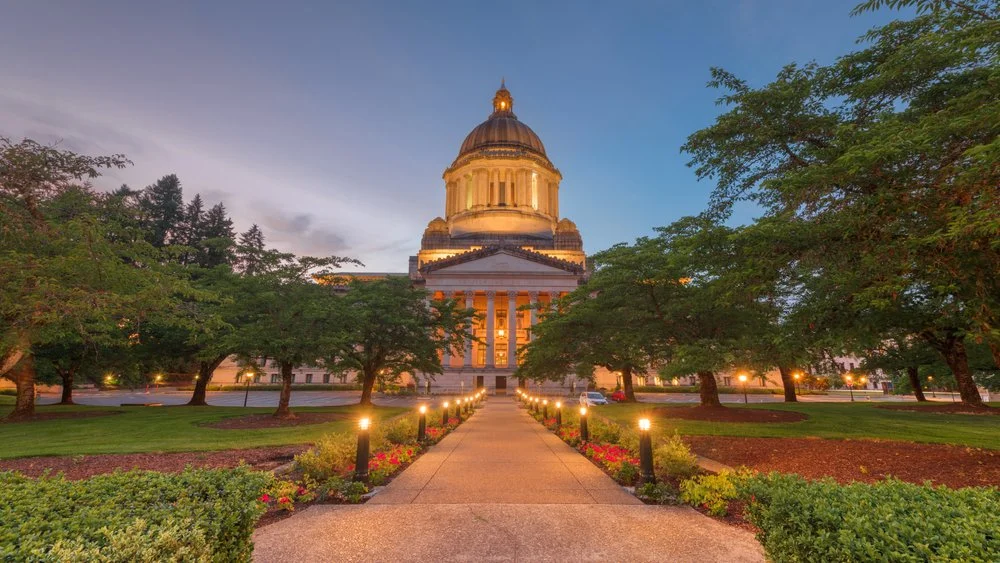
Image: Shutterstock
This Washington (Capitol Building in Olympia, Washington)
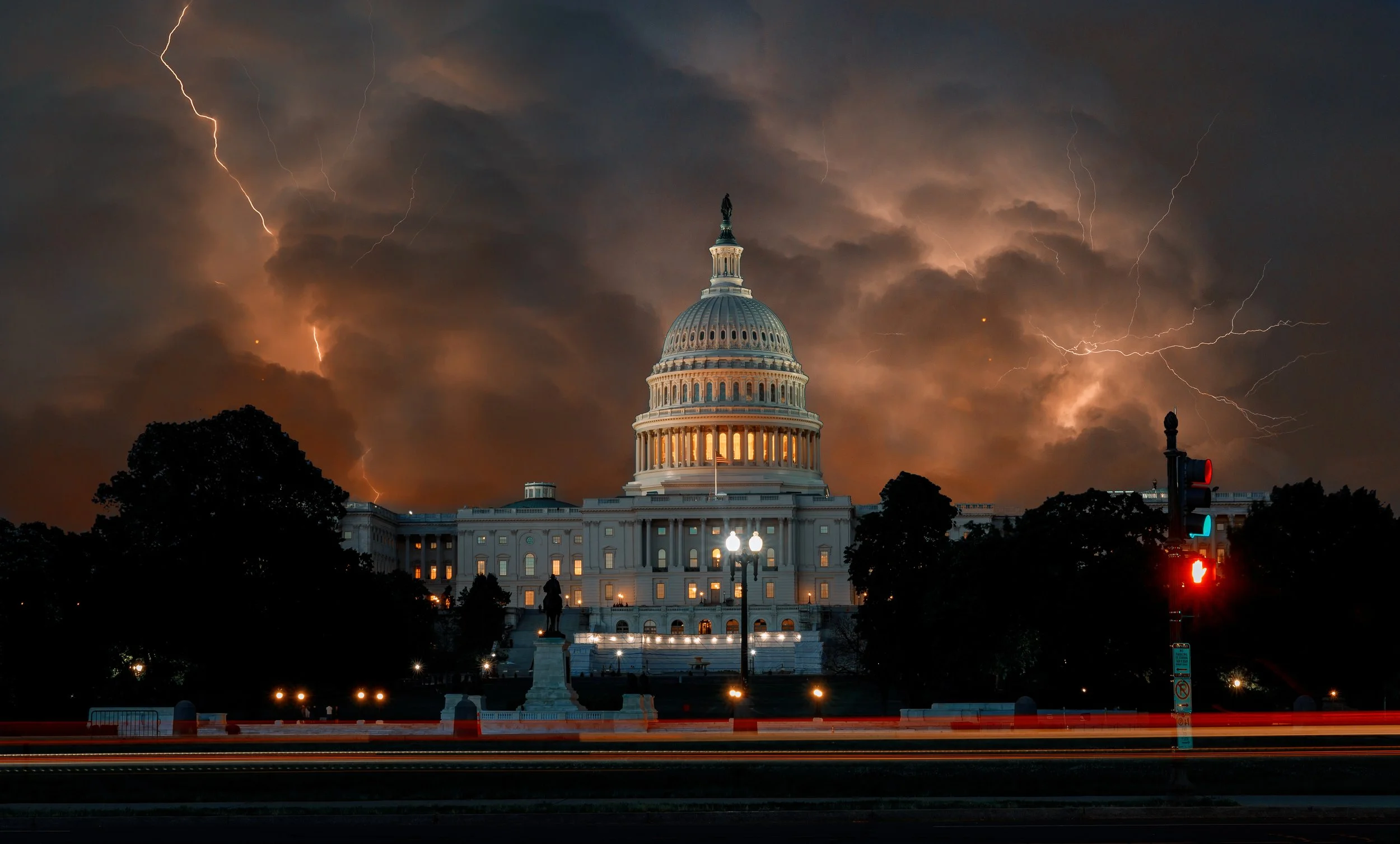
Image: Shutterstock
Not This Washington (Capitol Building in Washington DC)
Neither Kitsap Unitarian Universalism Fellowship (KUUF) nor its Social Justice Committee (SJC) has its own legislative agenda though, on occasion one or the other may take a stance. Instead, we encourage folks to consult the legislative agendas of a number of entities that have similar values to those of Unitarian Universalists. That is not to say we are totally aligned with everything in the agendas below or more importantly the bills to which they refer. SJC does, however, consider them a good place for Unitarian Universalists and others to start, using their own value based judgements to determine what is worthy of their support, opposition, or disinterest.
Table of Contents
Clicking on a line takes you directly to that information.
The entities below are listed in alphabetical order.
ACLU Washington
Protect drivers in Washington and their data from unregulated surveillance and federal overreach.
Increase fairness in the criminal legal system.
Stop the criminalization of our unhoused neighbors and assure that people can live securely in every community in our state.
Restrict and reform the use of solitary confinement (HB 1137)
Implement Trueblood Settlement Agreement and improve community supports and stability for Trueblood class members (HB 1218, HB 1195)
Change the Assault 3 statute to create a behavioral health exception (HB 1220)
Prevent isolation and restraint use in schools
Support sentencing discretion or review that allows community placement and reduced sentencing for some juvenile convictions
Allow people to seek resentencing after serving an extended period of time (HB 1125/SB 5269)
Allow sentence review for certain people who were under the age of 21 when their crime was committed (HB 1317)
Retroactively eliminate the use of juvenile felonies in the calculation of adult sentences (HB 1274)
Provide increased discretion for courts in stacking some sentence enhancements (HB 1178)
Support civic engagement of people in carceral setting
Allow elected members of the legislature to enter the premises of a state facility to tour the facility or meet with a constituent (SB 5342)
Support civic engagement opportunities for incarcerated folks and people in state institutions (HB 1147)
Create a Jail Oversight Board within the Office of the Governor to monitor jails (SB 5005/HB1424)
Provide parameters for conducting searches of transgender and intersex individuals confined in a local jail in compliance with federal law (SB 5490)
Improve oversight in carceral settings
Create a Jail Oversight Board within the Office of the Governor to monitor jails
(SB 5005/HB 1424).
Provide parameters for conducting searches of transgender and intersex individuals
confined in a local jail in compliance with federal law (SB 5490).
Support self-advocates with intellectual/developmental disabilities in efforts to close state operated Residential Habilitation Centers and increase oversight over the state-emergency transitional housing program.
Support efforts to increase transparency and accountability for unexpected deaths in treatment facilities under the control of the Department of Social and Health Services.Coordinate and support the police reform bills from the Washington Coalition for Police Accountability
Support the primary policy priorities of the Washington Immigrant Solidarity Network.
Environmental Priorities Coalition
Restore Wildfire Resilience Funding
Protecting Climate and Environmental Health Funding
Data Centers, Environmental Protection, and Affordability
Faith Action Network
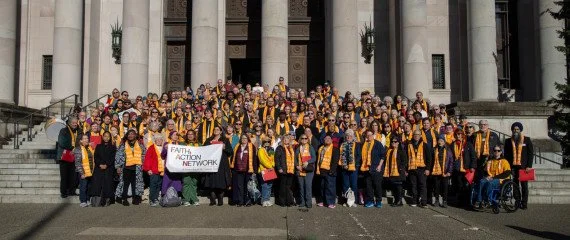
Interfaith Advocacy Day 2026
PURSUE ECONOMIC JUSTICE AND ENSURE BASIC NEEDS
Support Progressive Revenue: (HB 2100 Scott) and the emerging millionaires’ tax.
Pass a "Moral" budget: Preserve safety net and health programs in the face of a predicted $400 million shortfall in the 2025-2027 budget. Includes maintaining the food security budget, assistance to immigrant and refugee communities, and addressing health care.
Create a statewide energy assistance program for low-income households. (HB 1903 Mena)
Expand opportunities for Affordable Housing Developments (HB 1859 Salahuddin/SB 5885 Riccelli)
Maintain a Strong Housing Budget: Funding for Housing Trust Fund; Additional $3 million for evictions defense program to maintain number of lawyers (Budget)
Prevent local governments from denying or delaying permanent supportive housing, transitional housing, or emergency shelter projects based on zoning. (HB 2266 Peterson)
DEFEND and ADVANCE IMMIGRANT AND REFUGEE RIGHTS
Preserve Immigrant Health Equity Advocate for full funding of the Apple Health Expansion
Program to provide health coverage to all eligible low-income immigrant and refugee community
members (Budget)
Immigrant Worker Protection Act (HB 2105 Ortiz-Self/SB 5852 Saldaña)
Ban law enforcement officer masking (HB 2173 Cortes/SB 5855 Valdez)
Budget Proviso for Deportation Defense Hotline (Budget)
CULTIVATE CLIMATE & ENVIRONMENTAL JUSTICE
Defend Washington’s climate investments in the Climate Commitment Act threatened with cuts and diversions during this year of budget shortfall. Ensure the goal of directing 40% of environmental-related funds to overburdened and vulnerable communities for projects to reduce harm. (Budget)
Support full funding to the Wildfire Response, Forest Restoration, and Community Resilience Account at $125 million each biennium. (Budget)
Address the climate impact of data centers by requiring accountability for energy and water use and ensuring that siting and expansion align with climate goals (TBD)
CURB Pollution (HB 1303 Mena/SB 5380 Lovelett)
FOSTER RIGHTS, BELONGING & PLURALISM
Data and public records protection for patients and providers offering gender affirming and reproductive healthcare.
Regulate how public agencies can use Automatic License Plate Readers data so that civil liberties and immigrant communities are more protected (HB 2332 Salahuddin/SB 6002 Trudeau)
Stop Criminalizing Homelessness: Prohibits local jurisdictions from criminalizing life-sustaining activities in public when adequate shelter is not available and redirects resources from punishment to service providers.
Appoint a tribal member to the Board of Natural Resources (SB 5838 Kauffman/HB 2117 Stearns)
Tribal Traditional Cultural Places & Practices Protection (HB 2281 Stearns) strengthens Washington’s government-to-government relationship with tribes by expanding and formalizing protections for tribal traditional cultural places and practices. (HB 2281 Stearns)
Fair Score Act (HB 1274 Stearns/SB 5715 Kauffman)
Relieving legal financial obligations (LFOs) (HB 2102 Reed)
Second Look Pathway for Youth: Expands second look mechanisms to people given life or long sentences
before their 21st birthday through a review board. (HB1317 Hackney)
AG Investigations and Reform Bill: Authorize the Attorney General to investigate systemic misconduct in law
enforcement and corrections agencies. (HB 1056 Farivar/SB 5066 Hansen)
Standards for Law Enforcement Leaders: Strengthens, updates, and makes consistent eligibility requirements
and accountability standards for sheriffs, police chiefs and other law enforcement leaders. (SB 5974 Lovick)
REFORM OUR CARCERAL SYSTEM & SRENGTHEN POLICE ACCOUNTABILITY
Introduction
Front and Centered coalition, composed of diverse communities of color and low-income communities across the state, has been instrumental in advocating for policies that prioritize the involvement of frontline communities in developing environmental justice solutions. Our coalition will advocate for policies and investments that protect community members from environmental harm and build up the resilience of our communities.
Protecting the Safety Neta
Food assistance, housing assistance, Medicaid/healthcare, and other social services are at risk of being significantly compromised due to state budget constraints. With high inflation and an overall high cost of living, these services are now more important than ever to preserve for low-income Washingtonians who depend on these services for survival. We therefore urge the state to protect the following programs and protect the most vulnerable in the 2026 legislative session:
Food Assistance: Basic Food (SNAP) and State Food Assistance Program (FAP)
Temporary Assistance for Needy Families (TANF)/State Family Assistance (SFA)
Apple Health (Medicaid): The state's Medicaid program provides free or low-cost health coverage to eligible adults, children, and families.
Housing and Essential Needs (HEN) Referral Program: Provides housing and other assistance to low-income adults who are temporarily unable to work.
Low-Income Home Energy Assistance Program (LIHEAP): Helps low-income households pay for heating and cooling costs.
Child Care Subsidy Programs: Provides financial assistance to eligible low-income families to help pay for childcare.
Basic Food Employment & Training (BFET): Helps those receiving Basic Food benefits gain skills and work experience.
Cumulative Risk Burden (CURB) Pollution Act
House Bill 1303 Communities that have historically borne the worst effects of pollution due to redlining and institutional racism shouldn’t continue to bear the ongoing harm being inflicted on their health, well-being, and even life expectancy today. Yet under current laws, the processes that permit businesses to pollute are not required to consider the effects of historical environmental racism and the cumulative health burdens that frontline communities face.
Energy Assistance
House Bill 1903 Access to affordable, reliable energy is essential for every household, yet rising energy costs and outdated policies leave many families struggling to keep the lights on.
Environmental Justice — Investing Public Monies
Ensure all state funds live up to the HEAL Act goal that 40% of environment-related funds create environmental benefits to vulnerable populations and overburdened communities, and prevent harm. This includes all state funds derived from carbon pricing, operating and transportation, capital funds, and all federal funds. Specific community priorities for climate investments include:
Improving Accountability: When allocating investments dedicated to benefitting vulnerable populations and overburdened communities, it must be explicit, transparent, and not left to assumptions.
Sustaining Investments: Protect important investments in community capacity building and participatory budgeting that need to be sustained and expanded.
Revenue
While the legislature approved new revenue options during the last legislative session, it's apparent that Washington’s tax system needs restructuring to become more fair and to keep up with existing and new services. Front and Centered is a member of the Balance Our Tax Code Coalition, and our community members from all over the state are increasingly demanding big business and high-income earners to pay their fair share of taxes. Increasing prices and stalling economic growth are highlighting how an overreliance on taxes like the gas tax and sales tax—which are regressive and disproportionately impact low- and medium-income earners—leaves our state vulnerable to more and more budget cuts. There are many ways we can work together to tackle this problem, and we particularly support solutions that target a limited number of the wealthiest individuals and corporations while avoiding putting an undue burden on those who can least afford it.
JUUstice Washington sets its priorities in alliance with several coalitions including,
but not limited to, the following:
Front and Centered 2026 Legislative Priorities
Environmental Priorities Coalition
Keeping Our Communities Safe
Meeting Our Basic Needs
Ensure Local Governments House their Residents (HB 1195 & SB 5497 and HB 1235 & SB 5148)
Eradicating Poverty Fees, Alleviating the Burdens of Legal Financial Obligation (LFO) Debt (HB 1499)
Expanding Working Families Tax Credit (HB 1214 & SB 5768
Low-Income Energy Assistance Program (HB 1903)
Pay Pathways for Underserved Immigrant Students (SB 5115)
School Meals for All (HB 1404 & SB 5352)
WHY THESE LEGISLATIVE AGENDAS?
SJC is active in the Faith Action Network and JUUstice Washington because they share like values and believe in taking direction for their advocacy from those in marginalized communities. The other 5 legislative agendas included here are from organizations or coalitions led and run by people in marginalized communities.
IF I WANT ONGOING UPDATES, WHAT CAN I DO?
Action Alert Sign-up
One way is to click on the sign-up button to receive action alerts from one or more of the organizations or groups whose agendas have legislation in which you want to be involved. There is a button on this page for legislative alerts from each organization listed here that provides regular alerts.
Sign-Up with Take Action Network (TAN)
Take Action Network is a web platform designed for those who want to be more civically engaged. It matches your interests and engagement preferences to events and actions from organizations and groups you trust. Nearly all of the organizations/groups behind the legislative agendas posted here are TAN partners. You can sign-up by clicking here. If the link does not work when you try it, contact Mark Stroh for an alternative method as signing up can be tricky. But once you are on it is a very efficient way to stay informed. An advantage of this option is that they will send you one email a day combining all of the issues you have indicated covering the issues from all organizations/groups you have indicated.